Xevious review: the shooter that watched how you played

The verdict: a thoughtful, beautiful shooter that asks you to look down as much as up, and still rewards the player who pays attention.
- Made by
- Namco, designed by Masanobu Endō; released in North America by Atari, Inc.
- Released
- Japan and North America, February 1983
- Genre
- Vertically scrolling shooter
A ship flies north over forests, rivers and roads. Things come at it from the air. Things sit on the ground and shoot up at it. You have one button for the sky and another for the earth, and a little crosshair floating ahead of you shows where the bombs will fall. Xevious looks calm. It is not.
Two buttons, two worlds
The Solvalou carries a zapper for flying enemies and a blaster for ground targets, and the reticle in front of the ship shows where your bombs will land. That split is the whole design. You are always reading two layers of the screen at once, choosing whether the tank on the road or the fighter overhead is the thing that will kill you first.
It also gave the ground a reason to exist. The landscape is not wallpaper. There are targets in it, secrets in it, and even Nazca lines drawn into the terrain. You look down in Xevious in a way earlier shooters never asked you to.
Xevious was the first shooter where the ground felt like a place.
The game that noticed you
Here is the part most players felt without knowing. When you do well against a certain enemy type, a more advanced enemy type replaces it. Play badly and the game eases off. There is even a flashing radar on the ground, and destroying it makes the game switch back to easier enemies. The difficulty is a conversation, not a staircase, and that is a surprisingly modern idea.
Then there are the secrets. Bomb the right patch of empty ground and a hidden tower appears. Special Flags borrowed from Namco's Rally-X hand out extra lives. None of it is explained. It spread the way arcade secrets always did, from one kid to the next.
Xevious is a vertically scrolling shooter developed and published by Namco for arcades. It was released in Japan, and in North America by Atari, Inc., in February 1983. It was designed by Masanobu Endō and a small team. The player's ship, the Solvalou, has a zapper for flying enemies and a blaster for bombing ground targets.
Source: Xevious · Wikipedia (checked September 14, 2026)
Designed as a world
Masanobu Endō and a small team built it, and early versions were themed around the Vietnam War under the name Cheyenne before the game became the science fiction you remember. The shift shows. Xevious feels designed as a setting, not a level list, and that is why it still looks good.
What it meant back then
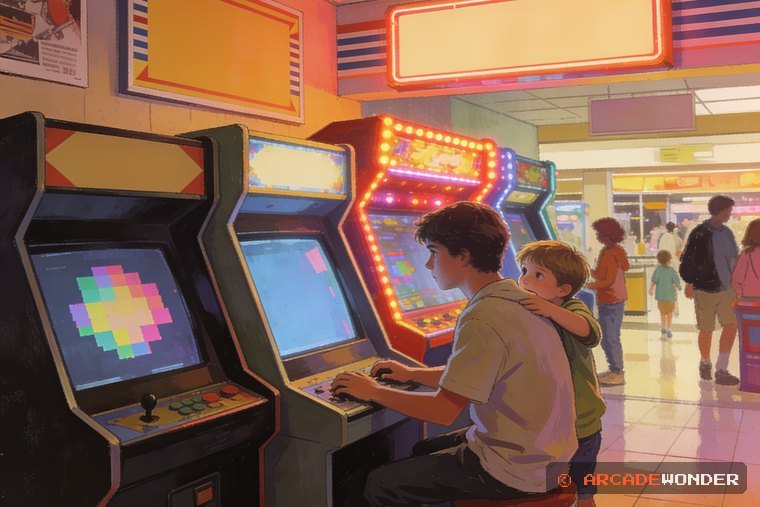
Here is the funny thing about Xevious in the United States. It was released by Atari, Inc., but the North American release paled in comparison to its fame in Japan. So it became a connoisseur's cabinet. At the mall arcade it stood among louder machines, and the kid playing it was usually the one who knew about the hidden towers and would not tell you where they were.
Playing it today
It is slower than the shooters it inspired, and that works in its favor. You have time to read the ground, to bomb deliberately, to hunt for secrets. Play it with patience and you will see why so many vertical shooters since have borrowed its sky and ground. It is still one of the most elegant in the genre.
Did you ever find one of the hidden towers, or did somebody have to show you?