Tron review: four games hiding behind one glowing grid

The verdict: a movie game that worked because it did not try to be one game, and whose light cycles still stand on their own.
- Made by
- Bally Midway, lead programmer Bill Adams
- Released
- North America, August 1982
- Genre
- Action
Each level of Tron starts on a grid split into four quadrants. You pick one, and only then do you find out which game you picked. Behind the squares are four different games: a light cycle race, a tank battle, a run at a tower full of bugs, and an attack on the MCP cone. Clear all four and the next level begins, named after a programming language, a lovely nerdy touch for a film about living inside a computer.
Four games, one control panel
The panel is a strange and clever piece of hardware. There is an eight-way joystick with a trigger for moving and firing, and next to it a rotary dial for aiming. Moving one way while spinning your aim another takes some getting used to, and once your hands learn it, the tank battle and the tower levels feel far more precise than a single stick could manage.
Light cycles is the only one of the four that ignores the dial. It is also the one everybody remembers. You steer a cycle that leaves a wall behind it, and you try to make the enemy cycles crash into walls, trails or each other before you crash yourself. Compared with the film, the colors are reversed, so your cycle is blue and the enemies are yellow.
Why picking blind works
The grid is the secret of the whole game. Because you do not know what is behind a square, every level starts with a small gamble. Get a sub-game you are good at and you breathe easier. Land on the one you hate and you have to deal with it. Lose a life and you go back to the grid, where the sub-game you failed now shows its icon, so at least you know what is waiting behind that square.
Tron did not squeeze a movie into one game. It broke the movie into four and let you choose.
The MCP cone asks you to chip a hole through a spinning wall of blocks. The I/O Tower sends you through crawling Grid Bugs toward a flashing circle. The tanks roam a maze. None of them would carry a cabinet alone, but together they make a machine you keep coming back to.
Tron was developed and published by Bally Midway for arcades, based on the Disney film of the same name, with Bill Adams as lead programmer. It was released in North America in August 1982. Electronic Games named it Coin-Operated Game of the Year.
Source: Tron (video game) · Wikipedia (checked September 14, 2026)
What it meant back then
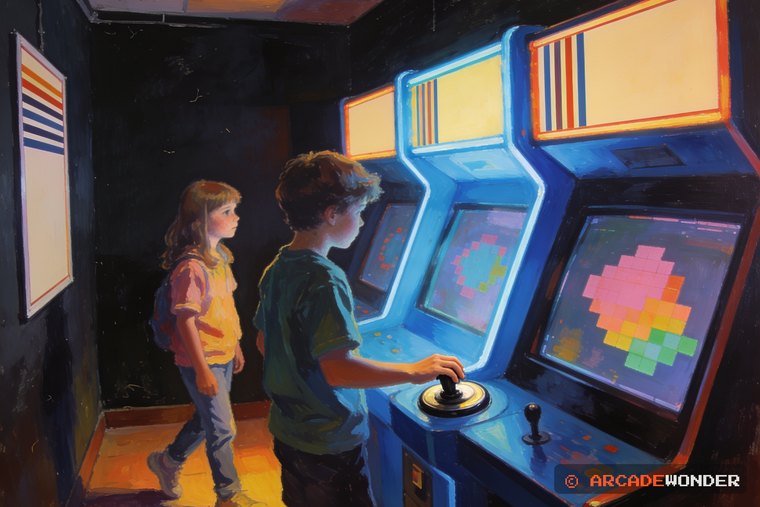
Tron was a movie game, and American kids who had seen the film at the multiplex went looking for it in the arcade. The cabinet glowed in the dark rooms of the mall, and for once the game in front of you actually felt like the world on the screen. Electronic Games named it Coin-Operated Game of the Year.
There was even a fifth game that did not make it in time. It was cut to meet the deadline and later came out on its own as Discs of Tron.
Playing it now
Tron is a better game than a movie tie-in has any right to be. The dial controls still feel special, and light cycles remains one of the cleanest head-to-head ideas in the medium. Give each quadrant a fair try rather than hoping for your favorite, and you will see why the variety was the point.
Which quadrant did you always hope you would land on?