Time Crisis review: the pedal that taught you to hide
![Arcade Longplay [1177] Time Crisis](https://i.ytimg.com/vi/tqL4Hi1VZrE/hqdefault.jpg)
The verdict: the gun game that made hiding feel as tense as firing, and a design that still reads clearly today.
- Made by
- Namco; producers included Toru Iwatani
- Released
- Arcade, December 1995
- Genre
- Light gun rail shooter
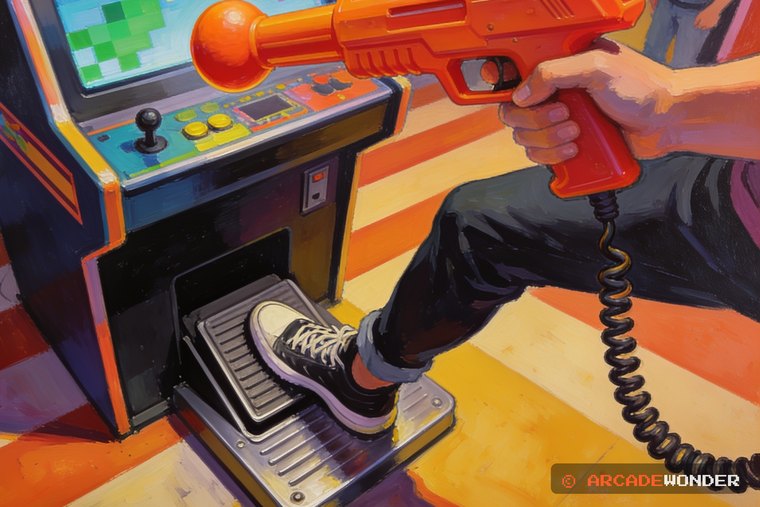
Step on the pedal and you are standing in the open, gun up. Lift your foot and you duck behind a crate while bullets hit the wall. That is Time Crisis in two sentences, and those two sentences changed what a light gun game could be about.
Why does a pedal matter so much?
Before this, the answer to danger in a gun game was to shoot it first. There was nowhere to go. Time Crisis gave the player a body. In the arcade version a foot pedal toggles between ducking and attacking, and hiding behind cover is also how you reload. Suddenly the game has a rhythm: pop up, fire, drop down, breathe, pop up again.
It sounds defensive, but the clock keeps it from being cautious. Each area starts with a one minute time limit, and the clock only gets relief when you clear a fight. Hide for too long and you lose anyway. So every trip behind cover is a small negotiation between safety and time, made with your foot while your hands are busy.
Letting the player hide is only exciting if hiding costs something.
The gun kicks back
The light gun has a blowback function that simulates recoil, so every shot pushes back against your hand. That physical feedback, plus the pedal, makes the cabinet feel like a place you stand in rather than a screen you point at. It is worth noting that Toru Iwatani, the name behind Pac-Man, is listed among its producers. Two very different games, the same instinct for a single clear idea.
Time Crisis was developed and published by Namco for arcades, released in December 1995. In the arcade version a foot pedal toggles between ducking and attacking positions, and each area starts with a one minute time limit. The light gun has a blowback function that simulates recoil. Toru Iwatani is listed among its producers.
Source: Time Crisis (video game) · Wikipedia (checked September 14, 2026)
What it meant back then
Time Crisis belonged to the big entertainment arcades of the late nineties, and to the movie theater lobby where it stood between the popcorn line and the auditorium doors. Dates played it. Dads played it while the kids finished their drinks. The pedal was the thing people explained to each other: not the story, not the villain, just "step on it to come out, let go to hide." Anyone could learn it in one credit, and nobody mastered it in ten.
Playing it today
The story is thin and the enemies are wooden, but the core idea is as sharp as ever. If you want to feel what cover in a shooter was before it was a button, find the pedal. Your foot still knows what to do after the first crate.
Were you the one who hid too long, or the one who never took a foot off the pedal?