Street Fighter II review: the game that put a stranger next to you

The verdict: the most important fighting game ever made, and still one of the clearest, because every character teaches you something different.
- Made by
- Capcom; designed by Yoshiki Okamoto and Akira Yasuda
- Released
- Arcade, Japan, March 7, 1991; worldwide, March 1991
- Genre
- Fighting
Somebody is halfway through the single-player game. A stranger walks up, drops a quarter in, and presses the second start button. The screen flashes, the computer opponent disappears, and now two people who have never spoken are fighting.
Why do six buttons matter so much?
The controls are an eight-directional joystick and six attack buttons: three punch buttons and three kick buttons, light, medium and heavy. That layout is the whole philosophy. A light punch is fast and weak, a heavy punch slow and strong, and every exchange is a small bet on which one reaches first. You can play it by mashing, and you can play it for years without running out of things to learn.
Special moves come from combinations of stick motions and buttons, and the famous combos came about more or less by accident, when players found that some moves flowed into others. The game was deep enough that its own designers had not found the bottom of it.
A good fighting game is a conversation. This one gave both people enough words to argue for a decade.
Eight fighters, eight lessons
There are eight playable fighters, Ryu and Ken plus six newcomers from around the world, and each one plays like a different game. Picking a character is picking a way of thinking: patient, grabby, fast, long-reaching. Losing to a new character teaches you something specific, and that is why losing never felt pointless.
It was designed by Yoshiki Okamoto and Akira Yasuda, who had worked on Final Fight, and you can see the same care in how clearly every hit reads. Even the bonus stage, smashing a car, is there to make you feel the weight of your buttons.
Street Fighter II is a fighting game developed and published by Capcom for arcades, released in Japan on March 7, 1991. It uses an eight-directional joystick and six attack buttons, offers a roster of eight playable fighters, and lets a second player join a single-player game to start a head-to-head match. It shifted arcade competition from personal-best high scores to head-to-head competition.
Source: Street Fighter II · Wikipedia (checked September 14, 2026)
The line of quarters
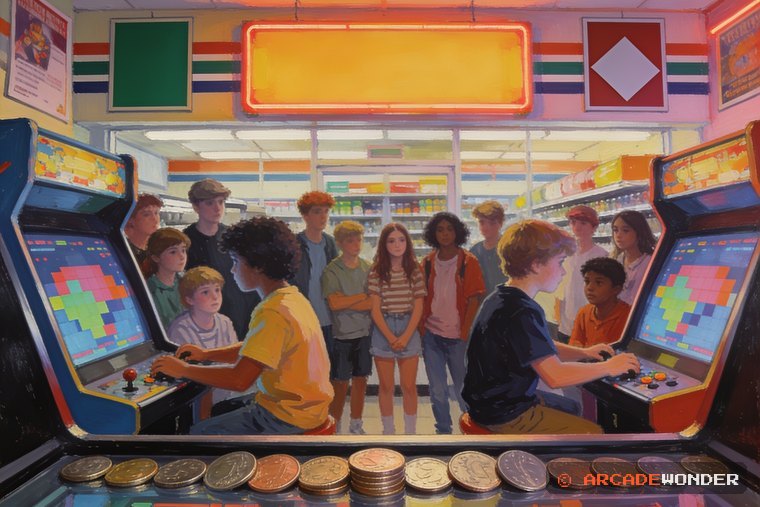
The second player rule changed American arcades. A second player could join any single-player game to start a head-to-head match, and the winner continues. So the room organized itself around one machine. Kids lined up quarters along the bottom of the screen to hold their place, crowds formed at the mall, at the 7-Eleven, at the pizza place, and the best local player became a minor celebrity.
The game shifted arcade competition from high scores to head-to-head competition, and it prolonged the survival of the declining arcade business. Anyone who remembers a room going quiet during a close final round already knows that.
Playing it today
Its later editions refined it, but the original is still clear, readable and sharp. Learn one character, learn one special move, and find a friend. The design only fully makes sense with a real person on the other side.
Who was the local player you could never beat, and which character did he always pick?