Robotron: 2084 review: two sticks and nowhere safe to stand

The verdict: the purest panic in the golden age arcade, and the reason two joysticks still feel right for this kind of game.
- Made by
- Eugene Jarvis and Larry DeMar of Vid Kidz, released by Williams Electronics
- Released
- North America, March 1982
- Genre
- Twin-stick shooter
A single figure stands in the middle of the screen. Then the wave starts, and robots pour in from every side. You have two joysticks. The left one moves you. The right one fires, in whichever direction you push it. That sounds like freedom, and for about three seconds it is.
One hand runs, one hand shoots
Before Robotron: 2084, most shooters made you face the way you fired. Here, running away and shooting behind you is one natural motion. It was not the first game with twin joysticks, but it is the one credited with making the idea popular, and after a single wave you understand why. Your hands learn the game faster than your head does.
Eugene Jarvis called the game an "athletic experience," and that is the right word. You lean, you grip, you breathe through your teeth. It is a physical game played on a flat screen.
Panic, on purpose
Jarvis and Larry DeMar said plainly that they wanted to make players panic, and they did it by giving you conflicting goals. Clear the robots to survive. Also, somewhere on the screen, members of the last human family are wandering around, and rescuing them is worth points. Some robots will kill those humans, and others will turn them into enemies. So every second you ask yourself whether to dive across the screen for a rescue or stay put and keep shooting.
The enemy list pushes that pressure further. Some are invincible giants your shots cannot kill. Some are robots that build other robots, which means ignoring them for a moment makes the wave larger.
Robotron does not ask whether you can aim. It asks whether you can think while everything is coming at you.
Robotron: 2084 was developed by Eugene Jarvis and Larry DeMar of Vid Kidz and released by Williams Electronics for arcades, reaching North America in March 1982. The left joystick moves the character and the right joystick fires. It was not the first game with twin joysticks, but it is cited as the one that popularized them.
Source: Robotron: 2084 · Wikipedia (checked September 14, 2026)
What it meant back then
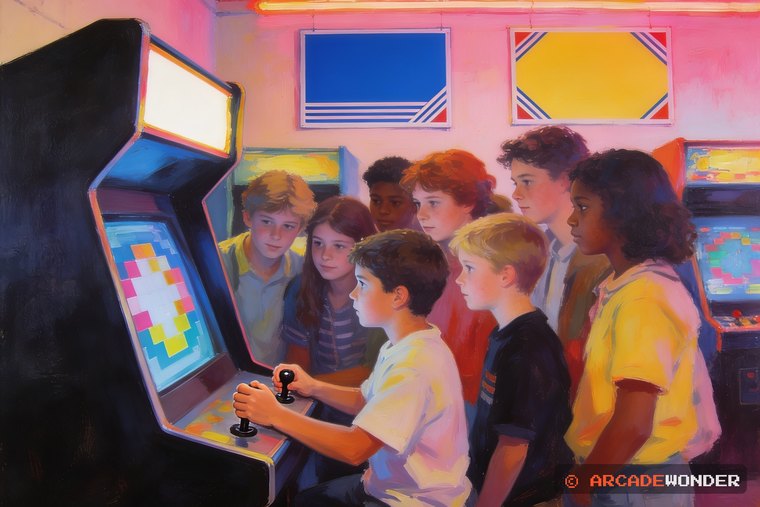
Robotron was never the friendly machine at the pizza place. It was the one the serious players gathered around at the mall arcade, the cabinet where a crowd formed to watch somebody who actually knew what he was doing. Its roots were plain to anyone who had played Berzerk, and its title nodded to Nineteen Eighty-Four, but the speed and noise were new. Standing behind a good player felt like watching a storm.
For everyone else, a quarter bought about as much time as it took to realize how much you did not know. And somehow that sent you right back for another try.
Playing it now
Robotron still works because the controls fit the problem so exactly. If you play it with a single stick, it is a different and worse game. With two, it is one of the most intense experiences the era produced. Start by ignoring the humans and just learning to keep moving, then start taking the rescues as your hands get braver.
Did you save the family, or did you just try to stay alive?