Q*bert review: a pyramid of cubes and a hero who swears
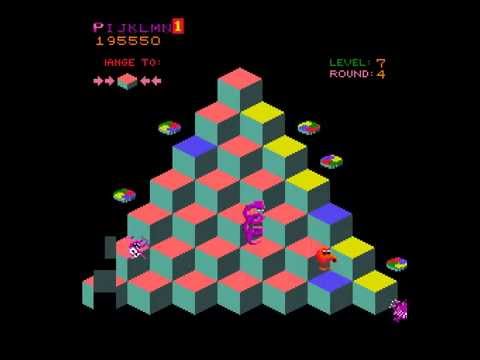
The verdict: strange controls hiding a very tidy puzzle, with the most satisfying escape trick of its era.
- Made by
- Gottlieb, designed by Warren Davis and Jeff Lee
- Released
- North America, October 18, 1982
- Genre
- Action, puzzle
An orange creature with a tube for a nose stands on top of a pyramid of cubes. Every time he hops onto a cube, its top changes color. Turn the whole pyramid to the target color and the stage is done. It sounds like a board game, and then a purple snake starts coming down after you.
The joystick that tilts the world
Q*bert only moves diagonally, and the cabinet was built to match, with a diagonally mounted four-way joystick. The isometric graphics give the cubes a solid, three-sided look that is lovely to watch and honestly confusing to steer. Your first games are mostly spent hopping off the edge of the pyramid by accident, which ends a life just as surely as the snake does.
That confusion fades, and what is left is a very tidy puzzle under pressure. Early stages need only one landing per cube. Later ones need two, or flip a cube back if you land on it again, so you have to plan a route instead of wandering.
The disc trick
Coily, the snake, chases you down the pyramid. Off to the sides float spinning discs. Jump on one and it carries you back to the top, and if Coily is close behind, he jumps after you and falls to his death. Luring the snake off the edge is the best feeling in the game, because it turns running away into a trap.
Two green creatures, Slick and Sam, cause trouble in a quieter way: they hop down and change your cubes back. They do not hurt you, but they undo your work, so you chase them while the purple enemies chase you.
The best move in Q*bert is running away at exactly the right moment.
Q*bert was developed and published by Gottlieb for arcades and conceived by Warren Davis and Jeff Lee. It was released in North America on October 18, 1982. It uses isometric graphics for a pseudo-3D look and is played with a single diagonally mounted four-way joystick.
Source: Q*bert · Wikipedia (checked September 14, 2026)

What it meant back then
Q*bert was Gottlieb's most successful video game, and the character traveled far past the arcade. Kids who never touched the cabinet knew him from lunch boxes, toys and a Saturday morning style cartoon. When he ran into an enemy, a speech balloon full of scrambled symbols popped over his head with a burst of garbled noise, and every kid in America understood that he was swearing.
That little cursing cloud was a big deal at the mall arcade. It was naughty enough to be funny and harmless enough that nobody's mom pulled them away from the machine.
Playing it now
The diagonal controls still take a few minutes to accept, and then the game opens up. It is part color puzzle and part chase, and you can see the whole board at once, so every loss feels like your own mistake. Short sessions suit it best: a few pyramids, one good disc trick, and a snake falling off the screen.
How many times did you hop off the pyramid before the controls made sense?