Pole Position review: you have to qualify before you can race
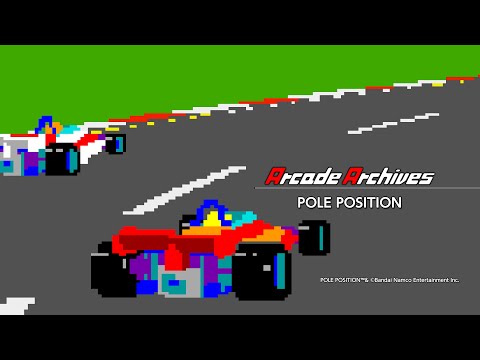
The verdict: the racer that set the rules for racing games, and one of the few early ones that still feels like a race.
- Made by
- Namco, created by Shinichiro Okamoto and Kazunori Sawano
- Released
- Japan, September 16, 1982; North America, November 30, 1982 via Atari, Inc.
- Genre
- Racing
You drop in your quarter and you do not get to race. Not yet. First there is a single time trial lap, alone on the track, and only if you finish it fast enough do you earn a place on the grid. That one decision is why Pole Position feels like motorsport rather than a game about dodging cars.
Qualify first
The qualifying lap is a quiet little test. It teaches you the circuit, the braking points and how the car handles, before anyone else is on the road. A good lap also puts you further up the starting order, so the practice pays off immediately. Then the real race begins, and everything you just learned has to work in traffic.
The circuit itself was the Fuji Speedway, laid out the way it really was. It was the first racing video game with a track based on a real racing circuit, and that gives every corner a reason to be where it is.
Paid to pass
Earlier driving games mostly rewarded you for staying on the road and not crashing. Pole Position gives a bigger reward for passing rival cars. That turns a survival test into an actual race. You are not only avoiding the car in front, you want to get past it, and you take risks to do it.
The risks are real. Take a corner too fast, run through a puddle or tap another car and you lose control for a moment. Clip one of the billboards along the edge and the car explodes. The game is fair about it, though. You always see what you did wrong, and the next lap you brake a little earlier.
Pole Position was the first time a lot of us learned that slowing down is how you go fast.
Pole Position was developed and published by Namco for arcades and released by Atari, Inc. in North America. It was created by Shinichiro Okamoto and Kazunori Sawano, and it came out in Japan on September 16, 1982, and in North America on November 30, 1982. It was the first racing video game with a track based on a real racing circuit, the Fuji Speedway.
Source: Pole Position · Wikipedia (checked September 14, 2026)
What it meant back then
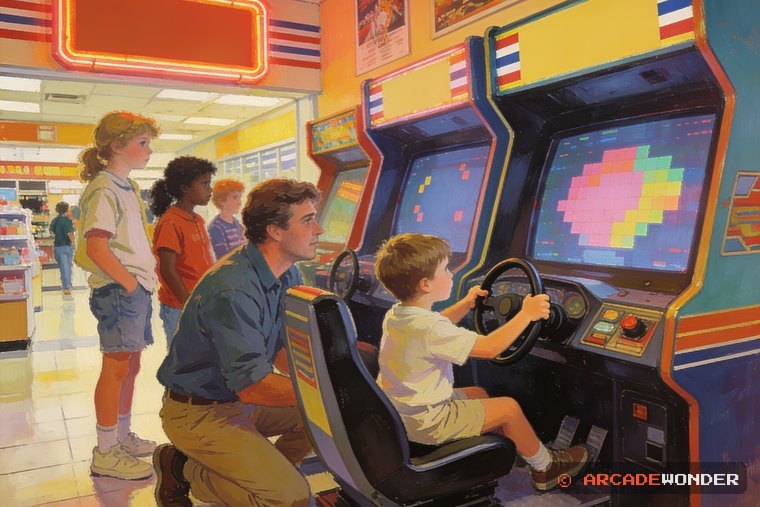
In North America Pole Position was the highest-grossing arcade game in both 1983 and 1984, and you could feel it. Every mall arcade, every roller rink and bowling alley seemed to have one, and the cockpit version, with its seat, wheel, gear shifter and brake pedal, was the machine everyone wanted to sit in. Atari advertised its "unbelievable driving realism," and to a kid who could not drive yet, it really did feel that way.
It got big enough to have its own Saturday morning cartoon. Even the name had a pedigree: Toru Iwatani, the creator of Pac-Man, picked it because he liked the sound of it.
Playing it now
Pole Position is still a satisfying drive because its rules are real racing rules. Learn the track in the qualifying lap, pick your moment to pass, and do not fight the corners. The low and high gears matter more than you expect, and a clean lap is as good a feeling now as it was in a noisy arcade.
Did you ever make the race, or did the qualifying lap send you home every time?