Pit-Fighter review: real people, real punches, stiff legs
The verdict: a stiff and limited fighter carried by its filmed actors and three-player chaos, better remembered as a spectacle than as a fighting game.
- Made by
- Atari Games, designed by Gary Stark and Mark Stephen Pierce
- Released
- North America, August 1990
- Genre
- Fighting
A big man in a tank top swings a fist at a guy in a leather jacket, and it looks like a video, because it basically is. People stopped in the aisle to watch this cabinet before they ever touched it. That was the trick, and for a while it was a very good one.
Filmed, not drawn
The game uses digitized live actors captured through a bluescreen process. Real people threw the punches and kicks in front of a camera, and the game plays that footage back. It was only the second fighting game to use digitized sprites, and in a room full of cartoon heroes it looked shockingly real.
The cost of that realism is movement. The fighters have only so many frames, so they feel stiff, turning slowly and landing hits with a kind of heavy lurch. You pick one of three: Buzz, a former professional wrestler, Ty, a kickboxing champion, or Kato, a black belt. Each has different speed and power, but none of them move like a Street Fighter character. You punch, you kick, and pressing all three buttons at once throws a super move.
It looked like a real fight on video. It moved like one filmed in slow motion.
The best part is everybody else
Where Pit-Fighter shines is the room around the fight. Up to three people can play at a time, and every fight is ringed by spectators. The crowd can interfere, attacking fighters, pushing stray players back in, and dropping weapons you can pick up. Grab a power pill and you get stronger for a while. With three friends on the panel, the stiffness stops mattering. It becomes a loud, silly brawl.
Every third fight is a Grudge Match, and if you are playing with friends, that means turning on each other. Get knocked down three times and you are out. The last one standing takes the bonus money, and the friendship takes a small hit.
Pit-Fighter was developed and published by Atari Games for arcades and designed by Gary Stark and Mark Stephen Pierce. It reached North America in August 1990. It uses digitized live actors captured through a bluescreen process, and up to three people can play at a time.
Source: Pit-Fighter · Wikipedia (checked September 14, 2026)
The Masked Warrior
At the end waits the Masked Warrior, the figure who taunts you between matches. If more than one person makes it that far, you have to fight each other first, and only the winner gets to face him. It is a great piece of arcade drama, even if the fight itself is rough.
What it meant back then
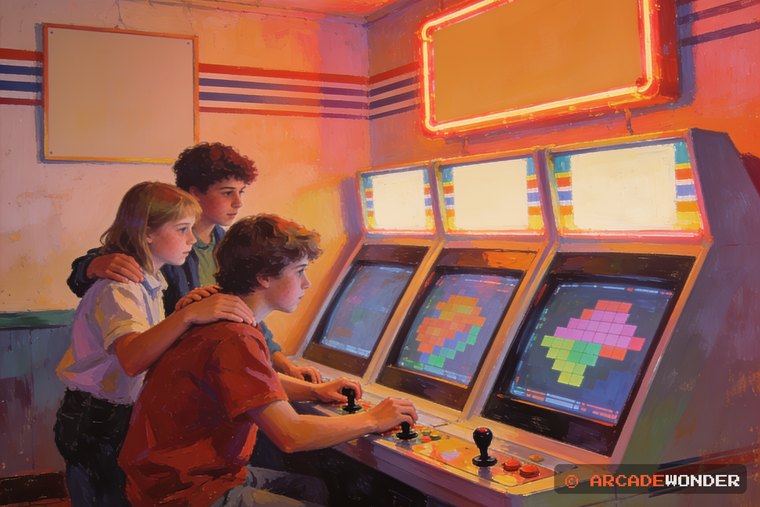
In American arcades that fall it was the top-grossing upright arcade cabinet on one national chart, and you could see why walking past. It looked like the late night action movies on cable, and it stood in malls and pizza places with three joysticks and a group of teenagers pressed together. It was a machine you played for the spectacle and the friends, not for the technique.
Playing it now
As a fighting game it is dated and stiff, and nobody should pretend otherwise. As a three-player party brawl with filmed actors and a crowd that joins in, it is still a strange and fun artifact. Get two friends, pick your fighters, and settle it in the Grudge Match.
Were you Buzz, Ty, or Kato, and did you fight your friends in the Grudge Match?