Lethal Enforcers review: six shots, then point it away
The verdict: a tense, simple cop shooter where the reload and the bystanders do all the work, and the photographs made it feel like more than a cartoon.
- Made by
- Konami, directed and designed by Yoshiaki Hatano
- Released
- North America, September 1992
- Genre
- Light gun shooter
The story starts with a cop at a donut shop, finishing his coffee, when the radio calls. A few seconds later you are holding a revolver pointed at a bank, and the people in the windows are not drawings. They are photographs. That is what made everyone stop and look.
Six rounds and a gesture
The revolver holds six rounds. To reload, you point the gun away from the screen and pull the trigger. It sounds like a small detail, but it shapes the whole game. Every reload takes your eyes and your aim off the action, so you start counting shots in your head and choosing the quiet moment to swing the gun away. Players who emptied the cylinder in a panic learned to regret it quickly.
Better weapons show up along the way, a shotgun, an assault rifle, a magnum, but get shot while carrying one and you lose it and go back to the revolver. So the game keeps pulling you back to its first idea: six careful shots, then reload.
Count to six. Point it away. Pray nobody walks into the window.
Who is who
The criminals and the bystanders share the same streets and the same photographed look. The rule is simple and fair once you know it: enemies always wear sunglasses, ski masks or gas masks, and civilians and fellow officers are barefaced. So every face that pops up is a split second test. Shoot fast, but read the face first.
You start as a Patrolman and earn a promotion after each stage, but shoot a civilian and you get demoted or stay stuck where you are. The rank ladder turns carelessness into something you can see.
Lethal Enforcers was developed and published by Konami for arcades, with Yoshiaki Hatano as director and designer. It reached North America in September 1992. Its graphics consist entirely of digitized photographs and digitized sprites, and the player is a Chicago Police Department officer named Don Marshall.
Source: Lethal Enforcers · Wikipedia (checked September 14, 2026)
The photographs that caused a stir
The realism was the point, and it was also the problem. The game caused controversy because it let players shoot photorealistic representations of enemies, at a time when that was new. But the crowd around the cabinet only saw a cop movie you could step into, with a second gun for a friend and a Chicago skyline behind the targets.
What it meant back then
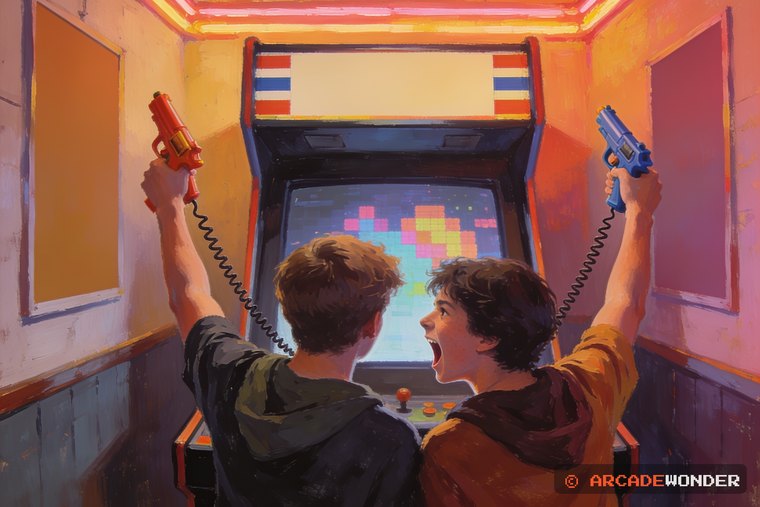
This was a big, bright cabinet in American malls and movie theater lobbies, with two holstered guns and a line of players. It was one of the top five highest-grossing dedicated arcade games of 1993 in the United States, which matches what you saw: two teenagers side by side, shouting "reload" at each other. The home version even came with a revolver-shaped light gun called the Justifier, but it was never the same as the cabinet.
Playing it now
It is short and simple, and the photographs look rough now. The design underneath still works. Count your shots, read the faces, reload on purpose, and try to reach Commander without a single mistake.
Did you ever make Commander, or did a bystander always get in the way?