Galaga review: the game that let the enemy borrow your ship

The verdict: a shooter built around a gamble, and the gamble is still the most interesting idea on its screen.
- Made by
- Namco, development led by Shigeru Yokoyama
- Released
- Japan, September 1981; North America, November 1981 via Midway Manufacturing
- Genre
- Fixed shooter
A swarm hangs at the top of the screen, peels off in loops, and dives at a ship that can only slide left and right and fire. That is Galaxian again, and Galaga is in fact its sequel. What made it a different game was one strange offer: let the enemy take your ship, and you might get it back doubled.
The tractor beam is a bet
The big Boss Galaga at the top of the formation can drop a tractor beam and haul your fighter away. You lose a life. That sounds like pure punishment, until you notice your captured ship sitting up there in the formation, waiting.
Shoot that boss while it dives at you and your old fighter comes home and locks onto the new one. Now you have a dual fighter, two guns side by side. Hit the boss while it is still parked in formation, though, and your captured ship turns against you and fights for the other side.
So every capture is a decision. Do you dodge the beam and play safe, or sit under it on purpose and gamble a life for twice the firepower? The dual fighter is also a bigger target, which means the reward makes you easier to hit. That is good design: the best upgrade in the game carries its own cost.
The game offered you a deal with the enemy, and most of us took it every time.
Breathing room built into the rhythm
Galaga does not only squeeze. Now and then it hands you a bonus stage, where the aliens fly through a preset pattern without firing a shot, and all you have to do is hit as many as you can. It is a pause and a test at once, and it teaches you to read flight paths you will need later.
Between those breaks the enemies grow more aggressive as the game goes on, diving faster and filling the air with more fire. The loops look pretty right up until they are aimed at you.
Galaga was developed and published by Namco for arcades, with Shigeru Yokoyama leading development, and it is the sequel to Galaxian. It came out in Japan in September 1981 and was released in North America by Midway Manufacturing in November 1981.
Source: Galaga · Wikipedia (checked September 14, 2026)
What it meant back then
In American arcades Galaga was the machine that never seemed to leave. It kept turning up on American arcade charts long after it arrived, and you could find it in pizza places, bowling alleys and the arcade at the mall, often in the same spot for years while newer cabinets came and went around it.
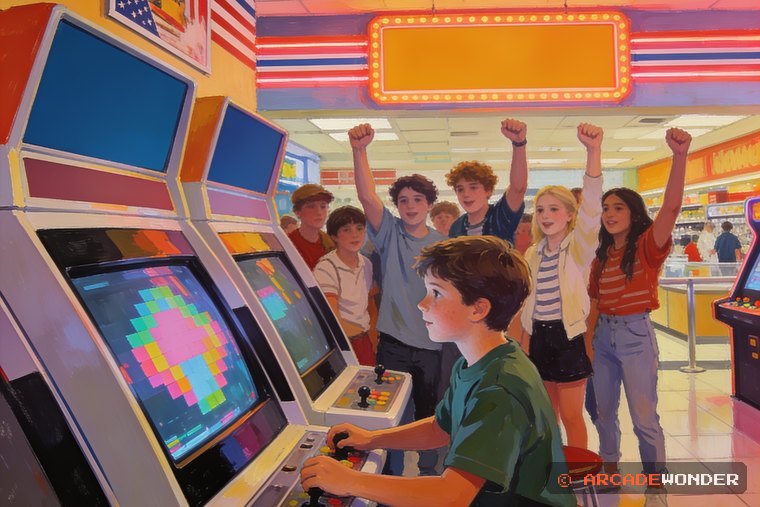
There was a ritual to it, too. A friend would let himself get captured on purpose while everyone crowded behind him, waiting to see if he could rescue the ship on the next dive. When he did, the group reacted like it was a touchdown.
Playing it now
Galaga holds up because its one big idea is still unusual. Very few shooters since have asked you to hand your ship to the enemy as a plan. Play a few rounds and you start setting up the capture instead of avoiding it, timing the rescue dive, and treating the dual fighter as something you earned rather than something you were given.
Did you ever let the tractor beam take your ship on purpose?