Daytona USA review: the race that read you on the first lap
![Daytona USA Longplay (Arcade) [4K]](https://i.ytimg.com/vi/X1V_2pvlAiE/hqdefault.jpg)
The verdict: a showpiece that was also a careful design, generous to beginners and stubborn with anyone who drove well.
- Made by
- Sega AM2; directed by Toshihiro Nagoshi; published by Sega
- Released
- Arcade, Japan and North America, March 1994
- Genre
- Racing
You drop into the seat, the wheel shakes in your hands, and a pack of stock cars is already ahead of you. Daytona USA was built to look like the future of the arcade. What makes it last is how carefully it treats the person in the seat.
How did it know how good you were?
Here is the quiet trick. The first lap of each race measures your skill, and the game adjusts the other cars to match. If you are struggling, opposing cars open lanes for you. If you are quick, they start blocking your line. A beginner gets a race that feels close. A strong driver gets a fight. Neither of them is told.
That one decision explains why the cabinet could keep a stranger and a regular equally happy. It is the same generosity that good arcade games always had, just done invisibly and at speed.
The kindest thing a hard game can do is decide, without telling you, how hard to be.
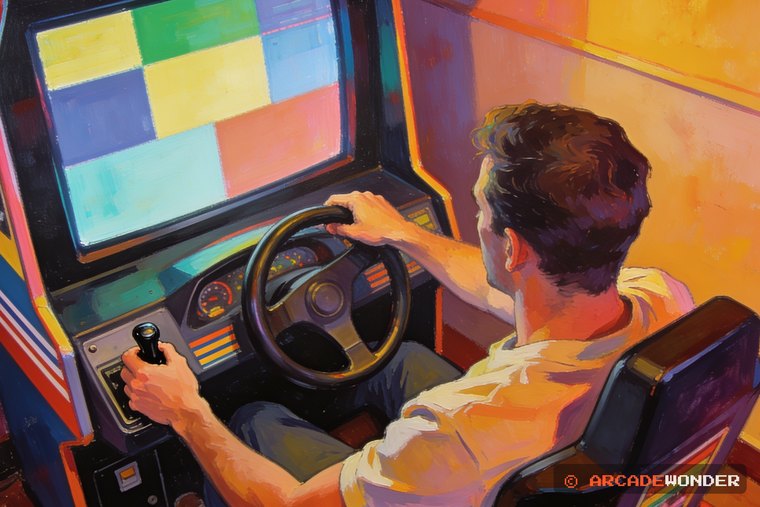
A stock car, a wheel that fights back
Inspired by the popularity of NASCAR, it has you race stock cars on one of three courses. The wheel uses force feedback, so you feel the bumps and the contact, and shifting is done with an H-type shifter, which made the manual transmission a small badge of honor. It was also the first game released on the Sega Model 2 board, and next to most of the room it looked smooth and bright in a way people stopped to stare at.
It was directed by Toshihiro Nagoshi at Sega AM2, and the care shows in the small things: the camera views, the drift through the turns, and a soundtrack people still sing along to, badly.
Daytona USA was developed by Sega AM2 and published by Sega for arcades, released in Japan and North America in March 1994. Inspired by the popularity of NASCAR, it has players race stock cars on one of three courses, and it was the first game released on the Sega Model 2 board. It uses adaptive difficulty based on the first lap, and linked cabinets let up to eight players compete.
Source: Daytona USA · Wikipedia (checked September 14, 2026)
What it meant back then
The linked cabinets were the event. Up to eight players could compete depending on how many were linked, and in a big American arcade or a family fun center that meant a whole birthday party racing at once. Strangers ended up side by side, glancing over between turns. It was also a very American fantasy built for that crowd: oval-track stock cars, loud engines, the kind of racing a lot of kids knew from Sunday television with their dads. The line to get a seat was part of the ritual.
Playing it today
It still feels quick, and the adaptive field is still clever enough to make a first-timer grin. Find someone to race beside you if you can. Alone it is a very good racer; with a friend it becomes the thing people remember.
Were you the one who drove the manual shifter, or the one who never touched it?