Bubble Bobble review: the game that told you to bring a friend

The verdict: a cute game with a ruthless clock and a warm heart, and still the best case for sharing one cabinet with someone you like.
- Made by
- Taito; designed by Fukio Mitsuji
- Released
- Arcade, Japan, 1986; North America, October 1986 via Romstar
- Genre
- Platform
A green dragon blows a bubble. An enemy floats up inside it, trapped. The dragon jumps into the bubble, it pops, and a piece of food bounces onto the floor. That is the whole idea, and it is enough for a hundred screens.
Why does a bubble make such a good weapon?
Players control Bub and Bob, trapping enemies in bubbles and popping them. Every defeated enemy turns into food you can grab for points, and if you catch several enemies and pop them together, the rewards get bigger. So the game quietly teaches you greed: do not pop them one at a time, herd them, stack them, and burst them all at once.
Bubbles are also terrain. They float for a while, and you can jump on them and ride them up to places you could not reach. Every screen is a single room with no scrolling, and the bubbles you make turn it into a different room every few seconds.
A good arcade game gives you one verb. A great one lets that verb solve three different problems.
The clock you cannot see
Bubble Bobble looks sweet, and it is not. Leave an enemy in a bubble too long, or dawdle on a screen, and the enemies turn angry, pink and faster. Wait longer and an invincible enemy shows up to chase you. There is no timer on the screen, but there is absolutely a timer.
Collect letter bubbles to spell EXTEND and you get a bonus life, which sends players chasing floating letters into danger they would otherwise avoid. It is a lovely piece of bait.
Bubble Bobble is a platform game developed and published by Taito for arcades, designed by Fukio Mitsuji and released in North America by Romstar. Players control Bub and Bob, two dragons who trap enemies in bubbles and pop them across 100 levels. Mitsuji hoped the game would appeal to couples who visited arcades, so he built it around its two player co-operative mode, and a single player who finishes it is told to come back with a friend.
Source: Bubble Bobble (video game) · Wikipedia (checked September 14, 2026)
A game built for two
Fukio Mitsuji hoped the game would appeal to couples who visited arcades, so he built it around two players working together. The design goes all the way to the ending. Finish level 100 alone and the game shows you a hint that reads "Come here with your friend", while two players who finish together get the happy end.
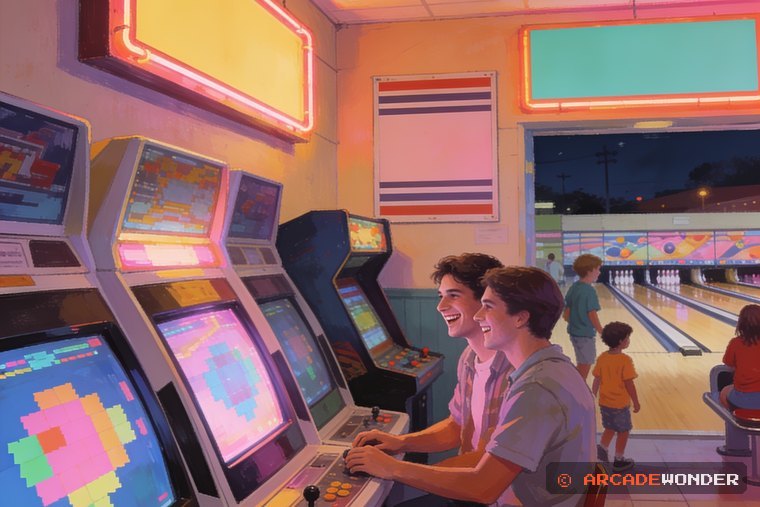
In American arcades, where it arrived through Romstar in October 1986, that made it the machine for pairs: brothers, best friends, the kid you just met at the bowling alley who had a quarter too. It sat a little apart from the loud fighting and shooting games, and it was the one you could talk through while you played.
Playing it today
The music gets in your head and stays for days. The game is still generous for ten screens and then gradually merciless. Play it with someone. The game has been telling people to do that since the start.
Who was your Bob, and did you ever make it to the real ending together?