Berzerk review: the room that would not let you stay
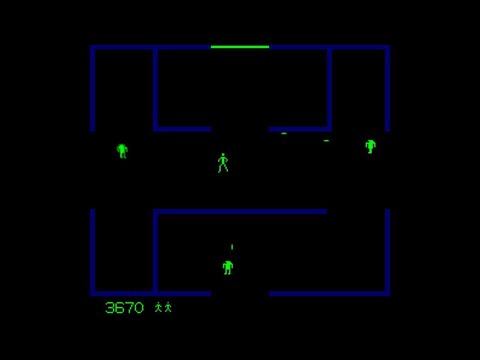
The verdict: a stark, mean and brilliant little machine that invented the idea of a clock you could see smiling at you.
- Made by
- Stern Electronics, designed by Alan McNeil
- Released
- November 1980
- Genre
- Maze shooter
A stick figure stands in a maze. Robots stand in the maze with it. The walls are deadly to touch. Somewhere behind you, a smiling face is on its way. Berzerk hands you all of that in the first two seconds and then lets you work out that the smartest move in the room is usually to leave it.
Standing still is how you die
Berzerk looks like a shooter, and the robots do go down when you hit them. But the design pushes hard against camping. The player cannot move while firing, so every shot is a moment you are planted. The robots can fire in eight directions. And touching a wall kills you as surely as a bullet does.
Then there is Evil Otto. He is a smiley face, he cannot be destroyed, and he can move through walls. He shows up after you have lingered, entering from the side you came in. There is no fighting him. He is the timer, drawn as a grin.
Evil Otto is a clock with a face, and the face is smiling.
Greed against nerve
Clear every robot in a room and you earn a bonus. Leave early and you keep your life. That is the real game. Each room asks how much you want those points, and the answer changes when you are down to your last man and the machine is starting to talk.
The talking mattered. After a salesman came by with a speech chip, Alan McNeil built digitized voices into the game to taunt the player, and Berzerk became one of the earliest games to use speech synthesis. A robot voice insulting you across a dark arcade was a new kind of pressure.
Berzerk was developed and published by Stern Electronics and designed by programmer Alan McNeil. It was released in November 1980, after Stern premiered it at the AMOA exposition in Chicago. Along with robots that move toward and shoot at the player, a smiley face called Evil Otto comes into each room, cannot be destroyed, and can move through walls.
Source: Berzerk (video game) · Wikipedia (checked September 14, 2026)
A small company's first swing
Berzerk was the first game developed in-house at Stern, designed by one programmer, and Stern premiered it at the AMOA exposition in Chicago before it went out that November. Its ideas carried on. Berzerk directly influenced Robotron, which took the rooms full of robots and turned the dial all the way up.
What it meant back then
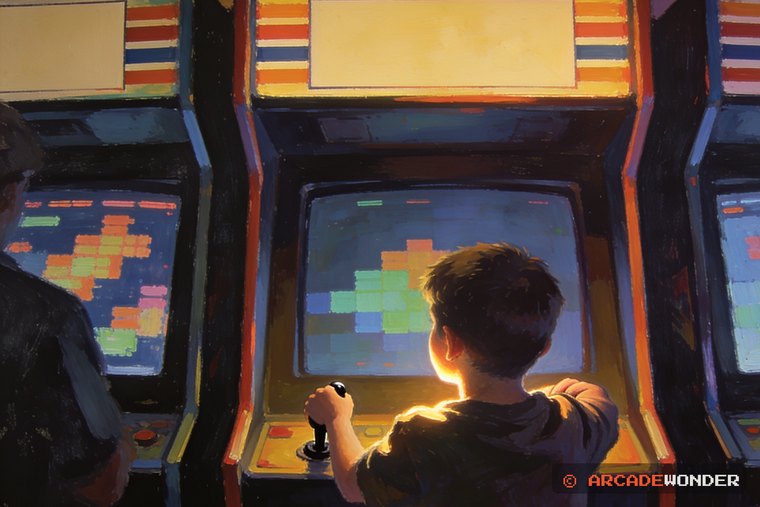
In 1980 an American arcade was loud, and Berzerk was louder in a strange way, because it spoke. You could hear it from the pinball row at the bowling alley or across a 7-Eleven, a flat mechanical voice calling out while some kid tried to decide whether to leave the room. It was a quarter that bought you tension more than action, and the tension is what brought you back.
Playing it today
It is spare to look at, just lines and flat colors, and that helps it now. Nothing gets in the way of the decision it wants you to make. Play a few rooms and you will feel it, that tug between one more robot and the door. Very few games since have made leaving feel this brave.
How long did you dare stay in a room before Evil Otto came through the door?