Battlezone review: the tank that put you inside the screen

The verdict: a first-person tank game built from a few green lines, and still one of the best lessons in using a radar to stay alive.
- Made by
- Atari, Inc., primarily designed by Ed Rotberg
- Released
- North America, November 1980
- Genre
- Vehicular combat, first-person shooter
You lean in and press your face to a periscope. Through it is a flat world tinted green and drawn in thin lines: a mountain range, an erupting volcano on the horizon, a few blocks and pyramids scattered across the plain. Somewhere out there is an enemy tank. It might be in front of you. It might be behind.
Two sticks, two treads
Battlezone does not give you a normal joystick. It gives you two joysticks, one for each tread. Push both forward and the tank rolls ahead. Pull one back and it spins in place. Leave one centered and it turns slowly while moving. It is a real control problem, and it makes the tank feel heavy and deliberate in a way no single stick could.
Your enemies come in order of rising danger: slow tanks, then fast missiles, then supertanks that hunt you aggressively. The blocks and pyramids are indestructible, so they are cover for you and cover for them. Now and then a saucer-shaped UFO drifts through for bonus points, never showing on the radar and never firing back.
The radar is the real screen
The view out of the periscope only shows what is in front of you. The battle surrounds you, and the radar at the top of the display is how you learn where the threat actually is. Good players watch the radar as much as the horizon, and turn early. New players look straight ahead, admire the view, and get shot in the back.
Battlezone taught a whole generation to check behind them before they checked in front.
Battlezone was developed and published by Atari, Inc. for arcades and primarily designed by Ed Rotberg. It was released in North America in November 1980. It used three-dimensional wireframe vector graphics and is considered the first true 3D arcade game with a first-person perspective.
Source: Battlezone (1980 video game) · Wikipedia (checked September 14, 2026)
What it meant back then
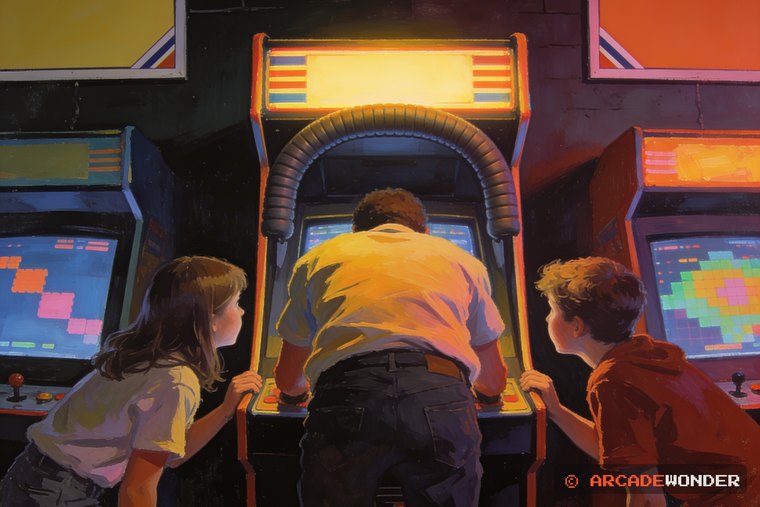
In an American arcade Battlezone was an event. The periscope cabinet looked like military hardware, and the wireframe world looked like the future. Onlookers could peer in from the sides of the viewfinder, so a small crowd would press around a player at the mall or the bowling alley while he turned his tank in circles hunting for the thing on the radar.
The game even crossed into the real military. A version called The Bradley Trainer was designed for the U.S. Army as gunnery training. Ed Rotberg, who led the original, only agreed to work on it after management promised he would never be asked to do military work again. It is a strange footnote, and it makes the quarter you spent on the civilian version feel a little more serious.
Playing it now
Battlezone feels primitive for about one minute and then it feels tense. The lines are simple, but the sense of space is real, and the two-tread steering still makes every turn a choice. Play it slowly, keep your eye on the radar, and use the indestructible blocks. It rewards the careful tank commander, not the one who charges.
Did you ever turn around just in time, or did the radar always tell you too late?