Arkanoid review: the paddle game that learned new tricks

The verdict: proof that you do not need a new idea to make a great game, only a better understanding of the old one.
- Made by
- Taito; designed by Akira Fujita and Hiroshi Tsujino
- Released
- Arcade, Japan, July 1986; North America, August 1986 via Romstar
- Genre
- Block breaker
A wall of colored bricks. A small paddle-shaped ship at the bottom. A ball. You have seen this before, and for about thirty seconds Arkanoid lets you believe it is the same old game.
An old idea, taken seriously
Arkanoid revitalized the concept of Breakout from a decade earlier, and the first thing it fixed was your hand. You move the Vaus, a paddle-like craft, with a control knob, so your paddle goes exactly as fast as your wrist does. There is no lag between wanting to be somewhere and being there. That precision is why the later screens can be so demanding.
Then it made the bricks interesting. Some take multiple hits. Some cannot be destroyed at all, so a level can hide its last brick behind a wall you have to find a way around. The ball stops being a thing you just return and becomes a thing you aim.
The best remakes do not add ideas. They find the ones the original left on the table.
Capsules change the rules
Break the right brick and a capsule drifts down. Catch it and the game changes for a while: a longer Vaus, the ball slowing down, extra balls, or cannons mounted on your paddle so you can shoot the bricks directly. Every capsule is a small gamble, because reaching for it can mean missing the ball.
That tension between greed and safety is the heart of Arkanoid. And at the very end waits DOH, where there is no continue. Whatever you brought with you is what you get.
Arkanoid is a block breaker developed and published by Taito for arcades, designed by Akira Fujita and Hiroshi Tsujino, and released in North America by Romstar. The player moves a paddle-like craft called the Vaus with a control knob to break a pattern of bricks. It revitalized the concept of Breakout from a decade earlier, and became the highest-grossing conversion kit of 1987 in the United States.
Source: Arkanoid · Wikipedia (checked September 14, 2026)
What it meant back then
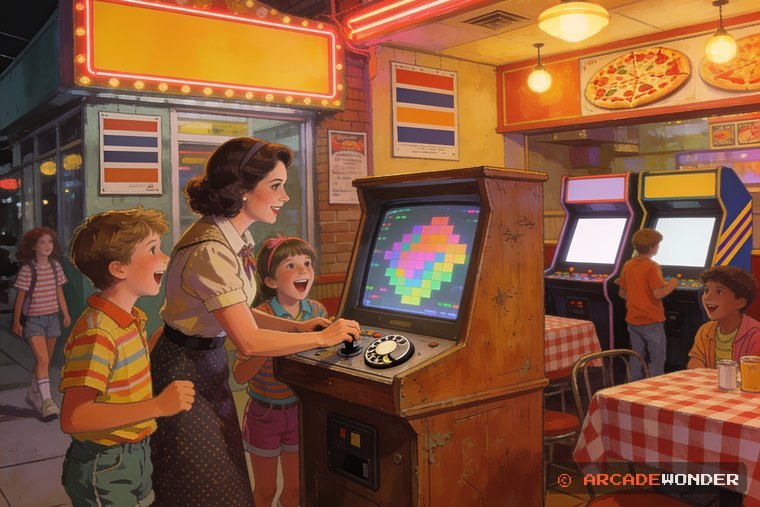
Akira Fujita and Hiroshi Tsujino won an internal Taito contest to make it, and borrowed the neon look from Tron, a movie American kids had already fallen for. In the US it came through Romstar and became the highest-grossing conversion kit of 1987, which meant it often showed up inside an older cabinet that an operator had given a second life. You found it at the pizza parlor and the corner store, the kind of places that never had the money for a big new machine, and it was one of the few games there your parents might actually try.
Playing it today
The knob matters. Played with anything less precise, it becomes a different and worse game. With the right control, it is still one of the purest tests of attention in arcade history. Break the wall, catch the capsule, do not look away from the ball.
Did you ever reach DOH, and did you have the laser when you got there?