After Burner review: the cabinet that flew with you
The verdict: more sensation than strategy and proud of it, the arcade at its most expensive, loud and gloriously overwhelming.
- Made by
- Studio 128 for Sega; designed by Yu Suzuki
- Released
- Arcade, Japan, July 1987; North America, October 1987
- Genre
- Rail shooter
The jet leaves the carrier deck. The music kicks in. A dozen enemy fighters come at you and the red light above the screen starts flashing. You have been playing for about eight seconds and you already feel like you are losing a fight you do not fully understand.
Speed first, understanding later
You fly an F-14 Tomcat through 18 stages with a machine gun and a limited number of heat-seeking missiles. The missiles lock on, the gun sprays, and you never have enough missiles for everything in the sky. The screen banks and spins so hard that the horizon becomes a suggestion.
After Burner is not subtle about what it wants. It wants you overwhelmed, and it wants you to come back to find out what you missed. Yu Suzuki gave it a Top Gun look so the whole world would understand it at a glance, and even the pauses in the action, the refueling and landing scenes, are there to give you a second to breathe before the next wave.
Some arcade games want to be understood. This one wanted to be felt in your stomach.
A cabinet that moved
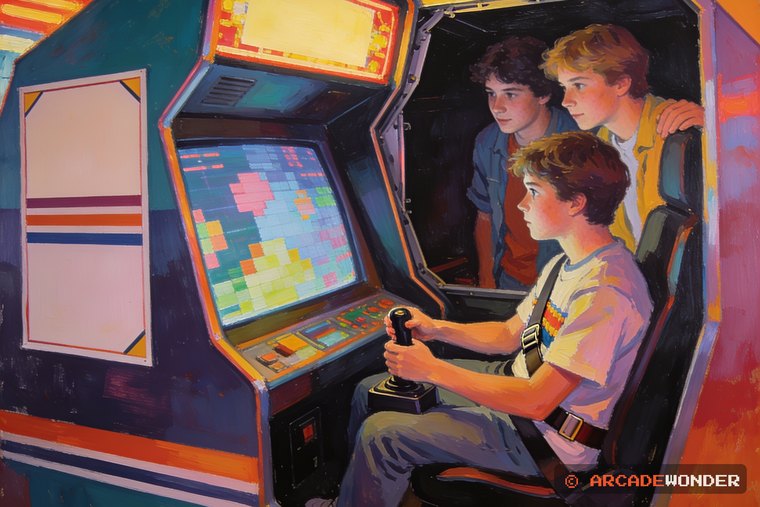
The deluxe version is the one people remember. It simulates an aircraft cockpit, with a flight stick, a chair with a seatbelt, and hydraulic motion that moves, tilts and rolls the whole thing in sync with the screen. There is something unforgettable about buckling a seatbelt to play a video game.
Even the plain upright cabinets had flashing lights at the top that warned you an enemy had a lock on you, which meant the danger was not only on the screen. It was blinking above your head.
After Burner is a combat flight simulation developed by Studio 128 and published by Sega for arcades, designed by Yu Suzuki and released in Japan in July 1987 and in North America in October 1987. The player flies an F-14 Tomcat through 18 stages with a machine gun and a limited supply of heat-seeking missiles. Its motion simulator cabinet has flight stick controls, a chair with a seatbelt, and hydraulics that move the cockpit in sync with the action.
Source: After Burner · Wikipedia (checked September 14, 2026)
What it meant back then
In the late eighties, Top Gun was the movie every American kid had seen or pretended to have seen, and After Burner was the closest any of us were going to get. In the US it came as a standard upright and a rotating cockpit deluxe version, and the cockpit was always the one with a small crowd around it, usually at the big mall arcade or the family fun center rather than the corner pizza place. It was among America's top five highest-grossing dedicated arcade games of 1988, which means a lot of quarters went through a lot of seatbelts.
Playing it today
Without the moving seat it is a faster, louder and shallower game than you remember, and it is still a thrill. Turn it up, keep rolling, and do not try to track every missile. Nobody ever could.
Did you ever get strapped into the moving cockpit, and did you walk out of it straight?