PengPong review: a penguin that never hits anything directly
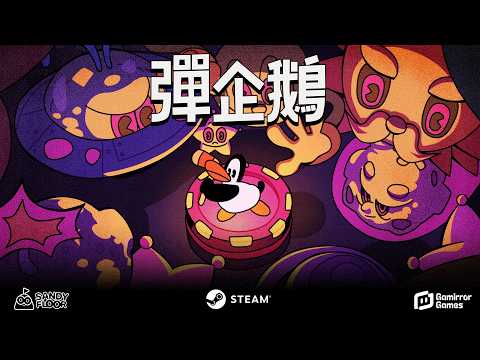
The verdict: a game that trades the satisfaction of a direct hit for angles and rebound. The whole thing lives in the shot that misses, comes back, and connects.
- Made by
- Sandy Floor, Korea
- Published by
- Sandy Floor and Gamirror Games
- Released
- August 20, 2026 (Steam)
- Genre
- Bullet-hell roguelike with pinball physics
- Play it on
- Steam (Windows, macOS)
We were not paid for this review, and the studio did not give us the game.
In the corner of most arcades stood one machine with no screen. A steel ball rattled under glass, you nudged the cabinet with your hip to change the tilt, and if you nudged too hard the machine shut you out. The person who was good at that machine was not the one who hit the ball. It was the one who already knew where the ball was going.
PengPong moves that knowledge into combat.
You do not hit. You bounce.
The rule is one line. Throw your weapon and let it bounce into things.
You throw hockey pucks. You throw guns. You throw earphones. You throw a pufferfish. Whatever leaves your hand hits walls and enemies and other objects, and changes direction each time. A shot that misses can come back and connect. A shot that lands well can ricochet somewhere useless.
Aiming straight at something mostly fails. You throw at where it will bounce.
So this is not a game about aim. It is a game about reading angles. The studio said as much in an interview: it puts more weight on hands-on control than others in this genre. This is not the kind of game where you stand still and enemies dissolve on their own. Your hands have work to do.
Every wave ends at a fork
A run is cut into waves. At the end of each one there is a fork. Sign a brutal contract, walk into the gambling den, or spend at the shop.
The gambling den says a lot about this game's character. You put chips down. If it goes your way the whole run gets easier. If it does not, you walk into the next wave with nothing. There are over three hundred items, so the same character ends up holding different things every run.
It works the way an arcade machine worked when it took one coin and sold you the next round. Here, instead of a coin, it asks you to stake what this run has built.
The face of a 1940s cartoon short
The art comes from the era of black-and-white American theatrical cartoons. Big eyes, rubber limbs, and smiles that sit slightly wrong. Adorable and unsettling share the same frame.
The lead is a former hockey star penguin with a debt to pay. The setup reads as a joke, but the hockey part is not one: bouncing a puck is the skeleton of the combat.
Made after missing with the last one
The Korean outlet Gamemeca reported that PengPong was designed to bring the studio back after the disappointing performance of its previous game, and that its working title during the in-house game jam was Pinball Survival. Sandy Floor released that previous game, the action battle royale Great Toy Showdown, in November 2024, and around ten developers were working on PengPong at the time of the interview. In the same interview the studio said this game puts more weight on hands-on control than other games in the Vampire Survivors mould.
Source: Gamemeca (Korean) · PengPong, a survivors-like with hands-on feel and vintage art (checked September 28, 2026)
How this game started is still visible in the game. After the previous one fell short of hope, the studio started again at an in-house game jam. Its working title then was Pinball Survival. The name changed; the skeleton did not.
For a team of that size there is a lot of hand-work on screen. Steam user reviews are very positive, controller support is proper, and a leaderboard pulls you back in to chase a number.
Playing it now
The good side is clear. Fighting with angles is rare in this genre, and the rarity holds all the way through. The feeling when a missed shot comes back and connects does not exist in games where enemies melt on their own. Runs are short, so you play one more the way you did at a cabinet.
The other side belongs here too. Because the bouncing is physics, some runs simply do not go where you wanted. If you cannot enjoy that as a variable, it grates. The gambling den leans on luck, and an unlucky run is hard to claw back by hand. Runs do not differ enough in what you actually do, so long sessions start to flatten.
If you want the satisfaction of hitting what you aimed at, this is the wrong game. What it gives you is not where you aimed but where it bounced. If you ever read a pinball table with your wrists, your hands will recognise this one first.
Do you remember standing at the pinball machine, reading with your wrists where the ball would go?